3 for Kiitos
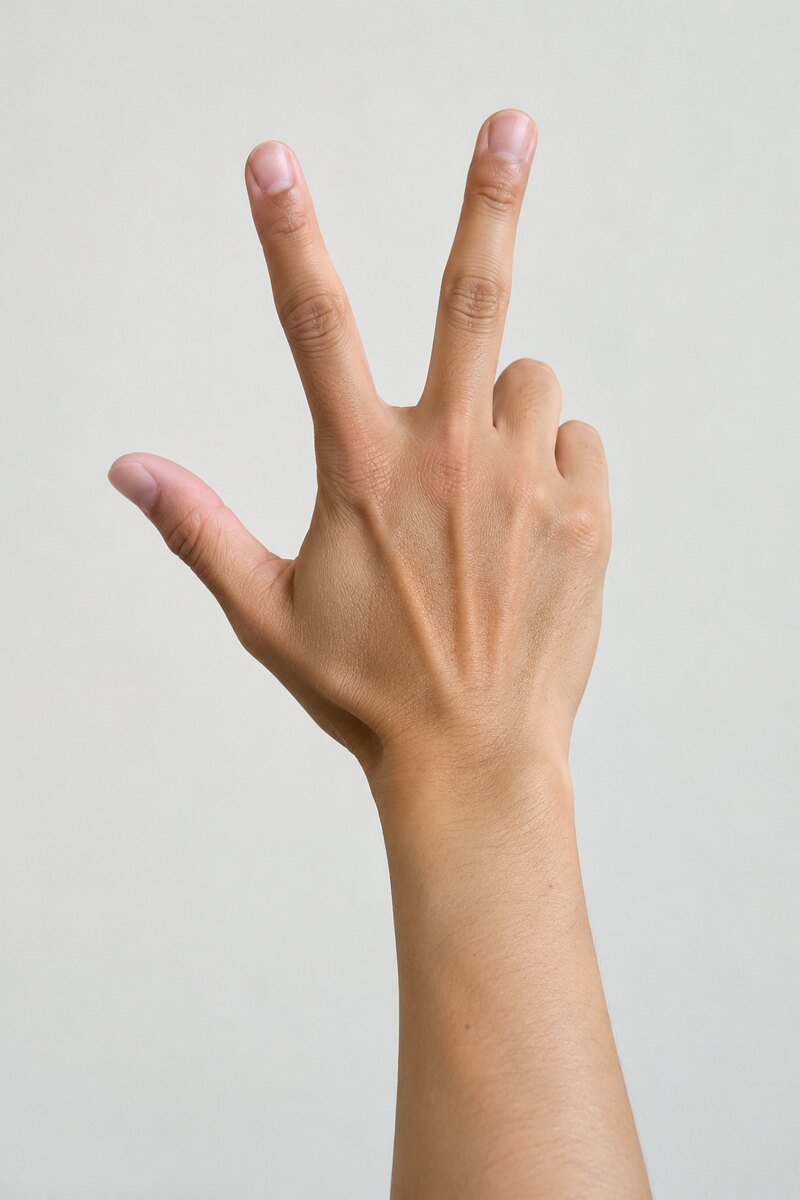
A thank-you you can make with one hand, in under a second, and hold still for a photograph.
v0, provisional. This is the first written definition. It has been used by one person in one friendly place, and it has had a desk screen for offensive meanings, not a clearance. It will change, and a change is a new version on this page, not a quiet edit. What is still unchecked is listed under What is not yet known.
The sign
Thumb, index and middle finger extended and spread apart. Ring and little finger folded. The back of the hand faces the person you are thanking, so they see a 3.
- Spread. The index and middle finger never touch. Touching reads as a finger gun, and a thank-you must not look like a threat.
- Upright, back of the hand to the viewer. This is the one canonical orientation. Held that way it reads as a 3.
- Held, not aimed. It is raised in view, never pointed at a person.
- A small wave is allowed. It adds emphasis. The still shape is the sign, and it is the one to photograph.
- Palm out is not the sign. It turns the shape into a letter k, and that shape already means something else to some people (see below). Do not use it, and do not teach it.
What it says
- 3. Thumb, index and middle finger make a 3, the 3 in Heart3ank, the wordmark of HeartBank®.
- Kiitos. Finnish for thank you, with kiitti its sister word. The three fingers also look like a lowercase k from the other side, which is where the name comes from and why that side is not the one we use.
- Thank you. Use it where you would nod, mouth the words, or give a quick wave: a driver who let you in, staff who wished you a good day.
Where the shape comes from
This hand shape is not new. It is the number 3 in American Sign Language, and in several countries it is how three is counted on one hand. We are giving it a second meaning, and we credit the Deaf community whose language it already belongs to. ASL has its own sign for thank you (fingertips at the chin, moving outward); this does not replace it.
What is not yet known
- Palm out collides with at least one established gesture. The Serbian three-finger salute is thumb, index and middle finger held up, and many Bosniaks and Croats read it as hostile. That is the main reason palm-in is the only orientation here.
- No gang-awareness source has reviewed this. Palm-in avoids the shapes we found warnings about, and we could not confirm that no local meaning exists. Treat it as unvetted until that review is recorded here.
- Reading by country is incomplete. We found nothing offensive about the palm-in shape, and the sources were thin, so that is a screen and not a clearance. Cambodia in particular is a gap.
- Adoption is untested. One person has used it at one gym. Whether strangers return it without being told has not been measured.
Clip art
One drawing, five skin tones. The file reads two CSS
custom properties, --hand and
--sleeve, so any tone is one line of CSS.
It is vector art drawn by hand for this page, not a
generated picture. Download the
SVG.

Use
The gesture is free for anyone to use. It carries no trademark and none is planned, because a thank-you spreads only if nobody owns it. The clip art follows the repository's license (Apache-2.0).